Oct 2025
Overview
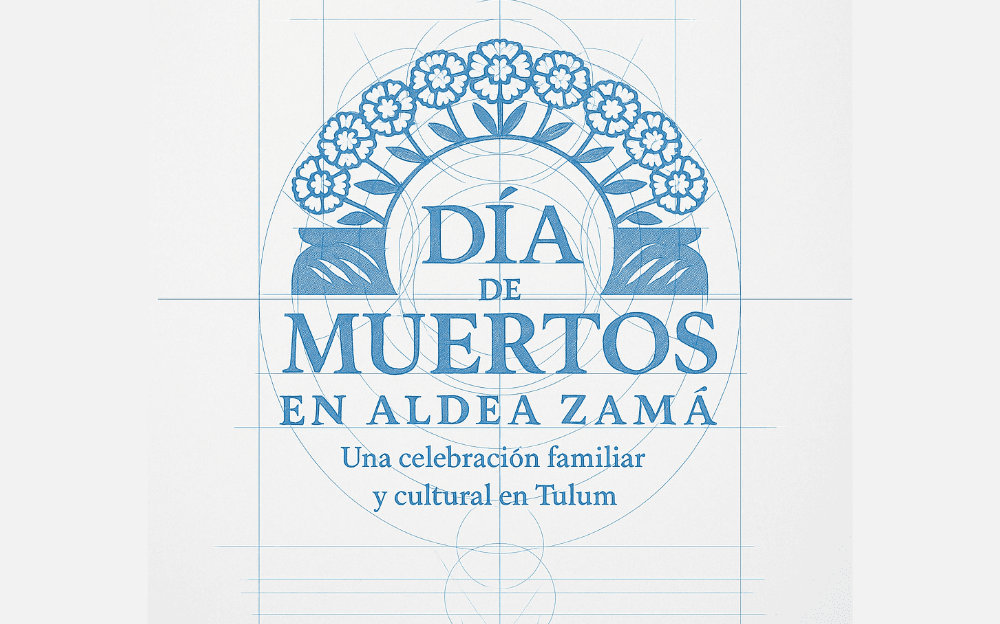
Camino de Luz was conceived as a spatial communication intervention during Día de Muertos in Aldea Zamá, Tulum.
The objective was not decoration. It was structure.
In a contemporary residential environment shaped by tourism, expatriate culture, and local Mexican identity, the challenge was to activate a deeply symbolic tradition without reducing it to aesthetic spectacle.
This project approached Día de Muertos not as folklore, but as a system of meaning.
Context
Aldea Zamá represents a hybrid cultural environment. It is neither traditional town nor purely touristic infrastructure. It is a transitional urban space.
In this type of environment, cultural symbols are easily aestheticized, commodified, or flattened into visual backdrop.
So, How do you introduce a tradition rooted in memory, ancestry, and ritual into a contemporary space without turning it into decorative consumption?
Communication Challenge
Día de Muertos installations often default to:
– Color saturation
– Decorative accumulation
– Photo-op scenography
– Instagram-driven spectacle
The risk was dilution. specially with all the other "Dia de Muertos" Celebrations around the area.
The project required clarity, restraint, and symbolic precision.
Strategic Decision
Instead of “decorating” the space, the intervention created a guided path.
The “El Camino” became the core communication device.
Light was used not as ornament, but as narrative structure — a directional, symbolic, and emotional guide.
The installation functioned as spatial storytelling:
– Sequential progression
– Rhythmic repetition
– Controlled visual hierarchy
– Night activation as experiential climax
This transformed the environment from backdrop into experience.
Design System
Outcome
The result was a communal experience that felt intentional rather than ornamental.
The intervention did not compete for attention.
It guided it.
Rather than selling tradition, it framed it.
" height="348.1284805327614px" id="uZbe5IwZS" transform="translate(0 -0.13)" width="358.99964134645063px"/></svg>)